


Running a Business on Calls: Why Service Vendors Need More than Skill to Grow
Learn why service vendors need structured workflows beyond calls and chats to manage leads, jobs, payments, and business growth effectively
Many local service vendors are highly skilled at what they do.
They can repair appliances, handle customer issues, visit different locations, and complete jobs with practical experience. But running a service business needs more than technical skill.
When leads, follow-ups, quotes, staff updates, and job details are handled only through calls, memory, and scattered chats, the business becomes difficult to manage.
This is where many vendors get stuck. They are capable of doing the work, but they do not always have the system needed to run the business smoothly.
Why Many Vendors Still Depend on Calls
For many small service vendors, the phone is the main business tool.
Customers call to explain the issue. Vendors remember details, note them down manually, or manage follow-ups through WhatsApp. Staff coordination happens through quick calls, and payment updates are often checked later.
This may work when the business is small. But as customers, jobs, and technicians increase, this method becomes harder to control.
Important details can get missed, follow-ups can be delayed, and job status can become unclear.
The problem is not the vendor’s capability. The problem is the lack of structure around the work.
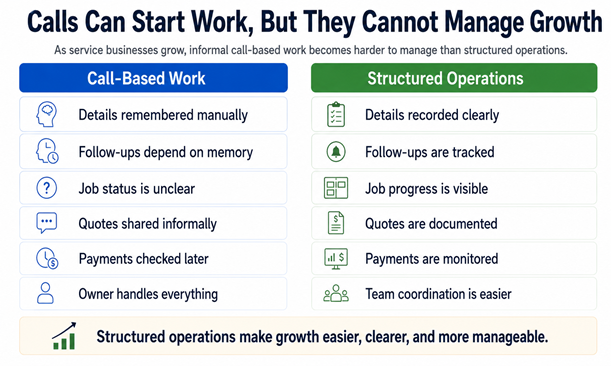
What Happens When Everything Depends on Memory
Memory works for small tasks, but it is not reliable for running a growing service business.
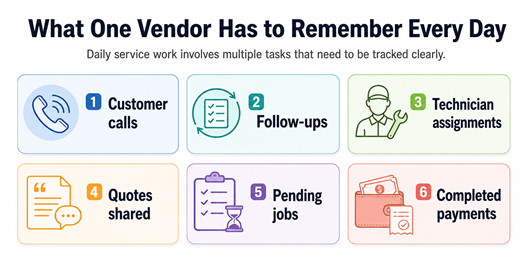
A vendor may need to remember:
- Who called
- Which customer needs a follow-up
- Which technician was assigned
- Which quote was shared
- Which job is pending
- Which payment is completed
When all of this depends on one person, the business becomes fragile.
If the owner is busy, unavailable, or handling multiple calls at once, important work can easily slip through.
This creates confusion for customers and pressure for the vendor.
The Hidden Cost of Manual Follow-Ups
In local services, a missed follow-up can directly mean a lost job.
A customer who does not receive a timely response may call another technician. A delayed quote may reduce trust. A forgotten service visit may damage the vendor’s reputation.
Manual follow-ups also take up a lot of time. Vendors spend hours:
- Checking chats
- Searching old messages
- Calling technicians
- Confirming job updates
Without a proper system, vendors are not only managing work. They are constantly chasing information.
Why Calls Alone Do Not Create Business Visibility
Calls help vendors communicate, but they do not create a clear view of the business.
At the end of the day, a vendor may not easily know:
- How many leads came in
- How many jobs were completed
- How many quotes were converted
- Which payments are pending
- Which service category is getting more demand
Without this visibility, it becomes difficult to make better decisions.
The vendor may feel busy, but may not know whether the business is actually growing, losing leads, or becoming inefficient.
Why Skilled Vendors Struggle to Scale
Many vendors are good at service work but struggle to move beyond owner-led operations.
This happens because the business depends too much on the owner’s personal effort. The owner receives calls, assigns work, follows up with customers, coordinates technicians, confirms payments, and remembers job details.
As long as everything depends on one person, growth becomes limited.
Even if there is more demand, the vendor may not be able to handle it properly without losing control over quality and coordination.
Skill brings customers. Structure helps retain and manage them.
From Phone-Based Work to Structured Workflows
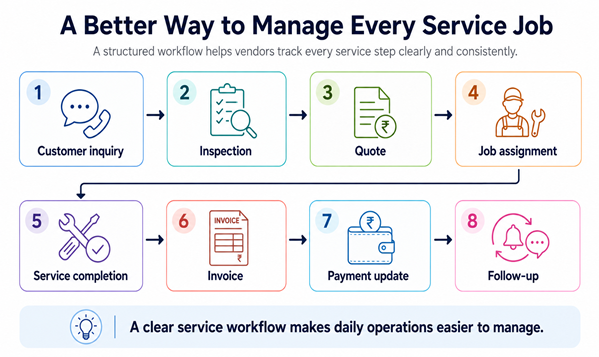
A structured workflow helps every job move through clear stages.
A service request can move from customer inquiry to inspection, quote, job assignment, service completion, invoice, payment update, and follow-up.
When this process is visible, vendors do not have to depend only on memory.
They can see what is pending, what is completed, and what needs attention.
This reduces missed work and improves customer experience.
Better Coordination with Staff
As vendors grow, staff coordination becomes more important.
When multiple technicians are handling different jobs in different locations, calls alone can create confusion.
For example:
- One technician may not receive complete details
- Another may not update the job status
- The owner may have to keep calling everyone for updates
A structured system can make coordination easier by keeping job details, assignments, and updates in one place.
This helps vendors manage teams more professionally and reduces pressure on the business owner.
Why Business Records Matter
A business without records is difficult to improve.
If leads, quotes, invoices, jobs, and payments are not tracked properly, vendors may not know where they are losing time or money.
Proper records help vendors understand:
- Which services are requested most often
- Which customers need follow-up
- Which jobs are pending
- Which payments are delayed
- Which technicians are handling more work
- Which areas bring more demand
This information helps vendors make better decisions and operate more like organized service businesses.
How Fatafat Service Supports Vendors
Fatafat Service helps vendors move beyond call-based and memory-based operations by giving them a more structured way to manage their business.
Through Vendors, vendors can:
- Organize leads
- Track jobs
- Manage quotes
- Handle invoices
- Monitor payments
- Coordinate work more efficiently
Instead of depending only on phone calls, notebooks, and scattered chats, vendors can bring their daily operations into a clearer workflow.
This helps service providers:
- Reduce missed follow-ups
- Improve customer handling
- Manage staff better
- Build stronger business visibility
For skilled vendors, Fatafat Service acts as an operational support layer that helps convert service capability into business maturity.
Moving from Capability to Business Maturity
Being good at service work is important, but it is only one part of running a successful service business.
A vendor also needs discipline in:
- Follow-ups
- Job tracking
- Customer communication
- Payment handling
- Team coordination
This is the shift from capability to business maturity.
Capability means the vendor can complete the work.
Business maturity means the vendor can manage work consistently, serve more customers, reduce missed opportunities, and grow with better control.
The Bottom Line
Many service vendors are skilled, but their business operations still depend heavily on calls, memory, and scattered chats. This creates confusion, missed follow-ups, weak tracking, and limited visibility.
Fatafat Service helps vendors move toward a more structured way of working through VendorOS, supporting:
- Leads
- Job tracking
- Quotes
- Invoices
- Payments
- Internal coordination
When vendors have a system behind their skill, they can manage work better, serve customers more consistently, and grow beyond owner-dependent operations.
FAQs
1. Why do service vendors need more than phone calls to manage work?
Phone calls are useful for communication, but they do not provide proper tracking, records, follow-up reminders, or business visibility. As work increases, calls alone become difficult to manage.
2. What problems happen when vendors depend only on memory?
Important leads, customer follow-ups, job details, staff updates, and payment information can get missed. This can lead to lost business and poor customer experience.
3. How does Fatafat Service help service vendors?
Fatafat Service helps vendors manage leads, jobs, quotes, invoices, payments, and internal coordination in a more structured way instead of relying only on calls and scattered chats.
4. Can Fatafat Service help vendors manage staff better?
Yes. A structured system can help vendors assign jobs, track updates, and coordinate technicians more clearly, especially when multiple jobs are happening at the same time.
5. Why is structure important for vendor growth?
Structure helps vendors handle more customers without losing control over quality, follow-ups, payments, and team coordination. It allows skilled vendors to operate like organized service businesses.