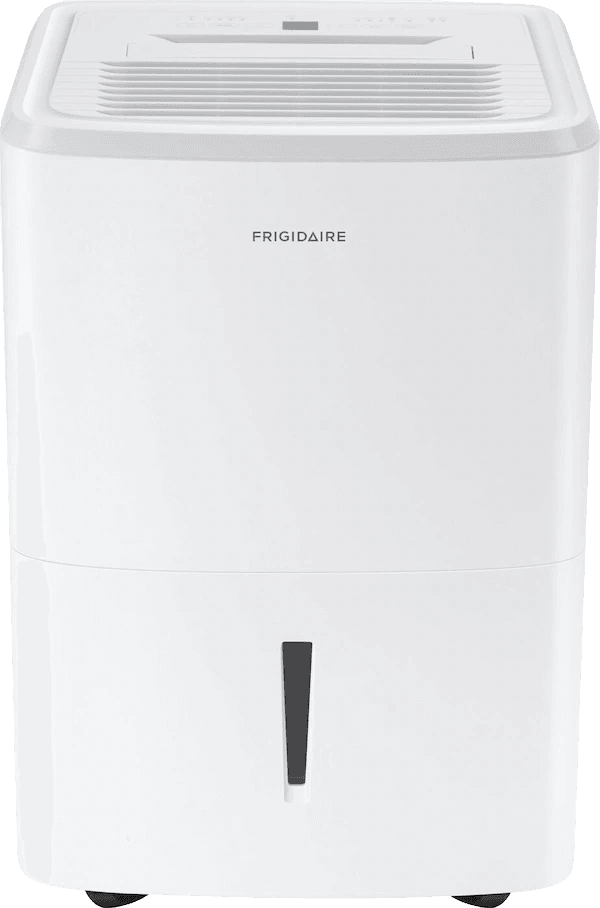
The refrigeration cycle engineering within the FHDD5034W1 utilizes a high-torque rotary compressor that facilitates a consistent phase change across the evaporator coils. By drawing warm, humid air over these cooled surfaces, the unit achieves a condensate extraction rate of 50 pints/day (~23.7 L/day). This compressor efficiency is critical in the Indian context, where ambient temperatures often range between 30°C and 40°C. In such high-heat environments, lower-grade compressors often struggle with thermal overload, but this rotary system maintains thermodynamic stability. The engineering focus on latent heat removal ensures that moisture is pulled from the air even when the sensible heat load is high, making it far more effective than standard air conditioning units in humid zones.
The use of R-32 refrigerant in the FHDD5034W1 provides a significant advantage in terms of heat transfer coefficients and operating pressure. R-32 has a higher cooling capacity and thermal conductivity compared to older R-410A variants, which allows the unit to operate more efficiently in the intense heat of an Indian summer. This refrigerant is particularly adept at handling high ambient temperature environments, ensuring the coils reach the necessary dew point to induce condensation quickly. Furthermore, R-32 has a lower global warming potential, aligning with modern environmental standards while providing the robust performance needed to pull gallons of water from the air daily in coastal cities like Chennai or Kochi.
Precision moisture management is achieved through an integrated digital humidistat that constantly monitors the room's relative humidity levels. The FHDD5034W1 features a control circuit with minimal latency between sensor reading and compressor activation, ensuring that once the humidity exceeds the set point, extraction begins immediately. The 35% to 85% range is strategically designed to cover diverse Indian use cases. For residential comfort in Goa, a setting of 50% RH prevents dust mites and mold, whereas server rooms in Bangalore may require a steady 45% RH to prevent electrostatic discharge or component corrosion. This versatility in sensing makes the unit a viable tool for both heritage home preservation and modern technological equipment protection.
Thermal management is further enhanced by an automatic defrost mechanism that protects the evaporator from ice accumulation. While India is primarily tropical, hill stations like Shimla, Munnar, or Ooty experience temperatures where the evaporator coil can drop below the 41°F threshold, causing frost buildup that impedes airflow. The auto-defrost cycle temporarily halts the compressor while running the fan to melt the frost, ensuring the unit remains operational in colder, damp climates. This feature is equally important for night-time operation in air-conditioned rooms where the ambient air is already pre-cooled, preventing mechanical strain and ensuring the device can run continuously without manual intervention or risk of freezing the internal components.
The fluid dynamics of the system are supported by a 16.9 pints reservoir and a high-velocity air circuit. At 80% RH, a common level during the Mumbai monsoon, the tank will fill several times daily, necessitating either frequent manual emptying or the use of the continuous drain port. The air circuit is driven by a 3-speed fan delivering 174 CFM on the low setting, which balances the need for rapid air exchange with a manageable noise profile of 49-51 dB. This airflow rate is optimized to ensure that the entire volume of a 1200 sq. ft. (~111 m²) space is processed multiple times per hour, maximizing the moisture extraction efficiency vs noise trade-off for residential users.
Maintenance and build quality center around the 19.51 kg chassis, which is reinforced for durability and equipped with heavy-duty caster wheels for multi-room portability. The primary air intake is protected by a reusable mesh filter designed to capture suspended particulate matter that could otherwise coat the internal coils and reduce heat exchange efficiency. In the dusty environments of Indian urban centers, regular cleaning of this filter is the primary maintenance requirement to ensure long-term operational costs remain low. The inclusion of an auto-restart function ensures that after the frequent power fluctuations common in many Indian regions, the system resumes its previous settings. These engineering considerations make the FHDD5034W1 a definitive moisture control solution for the Indian subcontinent.