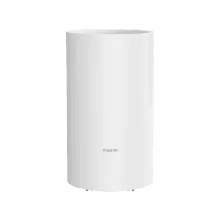
The thermodynamic efficiency of the DM-CS13BFA5B relies on a meticulously calibrated refrigeration cycle optimized for the Indian subcontinent. The internal rotary compressor facilitates the phase change of the refrigerant, cooling the evaporator coils to a temperature significantly below the dew point of the incoming ambient air. As the 140 m³/h fan draws in humid air, moisture condenses on these coils and gravitates into the 3.0L reservoir. This process achieves a consistent extraction rate of 13L/day (30°C/80% RH) in typical coastal conditions. Unlike standard reciprocating compressors, the rotary design minimizes friction and energy loss, which is critical in India where ambient temperatures often fluctuate between 30°C and 40°C, placing higher thermal loads on the system components.
Technical differentiation for the DM-CS13BFA5B is centered on its use of R-290, a high-purity propane refrigerant. While older models in the Indian market may still utilize R-410A, which has a Global Warming Potential (GWP) of 1430, R-290 has a GWP of only 3. This choice reflects a forward-looking engineering approach aligned with India's Kigali Amendment commitments to phase down HFCs. From an HVAC engineering perspective, R-290 possesses superior latent heat of vaporization, meaning it can absorb more heat per unit of mass compared to synthetic refrigerants. This results in higher energy efficiency and faster moisture removal in the humid, tropical heat of cities like Chennai or Kochi, making the unit both environmentally responsible and operationally cost-effective.
Precision humidity control is managed by an integrated digital humidistat that provides real-time feedback to the control logic board of the DM-CS13BFA5B. The sensor detects the relative humidity (RH) with high accuracy, allowing the unit to toggle the compressor based on user-defined parameters. Although the specific operational range is not specified, the logic is designed to accommodate the varied requirements of Indian users, ranging from the 45% RH needed for sensitive electronics in home server rooms to the 55% RH ideal for residential comfort. By managing the latency between the sensor reading and compressor activation, the system prevents short-cycling, thereby extending the lifespan of the motor and reducing the overall power consumption during long-term seasonal operation.
Operating within a temperature range of 5°C to 35°C, the unit includes an intelligent auto-defrost mechanism essential for varied Indian geographies. In hill stations such as Munnar or Shimla, where indoor temperatures can drop significantly, frost may accumulate on the evaporator coils during the dehumidification process. The system detects this restriction in airflow and automatically suspends the compressor while keeping the fan running to melt the ice buildup. This feature ensures that the unit remains operational and efficient even in cold and damp environments where traditional dehumidifiers might fail. This engineering failsafe is crucial for users who run the device overnight in air-conditioned rooms or in cooler high-altitude regions across the country throughout the year.
The air circuit of this 11.1 kg unit is designed for maximum throughput, featuring a 140 m³/h airflow rate that ensures rapid air exchange in the target area. The variable speed fan allows users to balance the extraction speed against the noise level, which peaks at a quiet ≤ 38 dB(A). For drainage, the 3.0L tank provides several hours of operation in high-humidity zones like Goa. However, for continuous unattended use, the unit features a gravity-fed drain port. This is particularly useful in Kerala's backwater regions where humidity remains consistently high. By bypassing the tank, the system can run indefinitely, protecting unoccupied holiday homes or basement storage areas from the relentless moisture that characterizes the post-monsoon season in coastal India.
Structural durability is evident in the 11.1 kg chassis, which is equipped with smooth-gliding caster wheels for effortless relocation between a damp wardrobe and a humid bedroom. Maintenance is simplified through a washable dust filter that protects the internal refrigeration components from particulate accumulation. For Indian households, regular filter cleaning is the primary requirement for maintaining the 190W rated efficiency and preventing airflow resistance. The unit’s direct compatibility with the 220-240V power grid eliminates the need for external voltage converters, ensuring a stable performance profile across all Indian urban centers. Given its technical specifications and energy-conscious design, the DM-CS13BFA5B stands as a professionally engineered solution for anyone seeking to mitigate the destructive effects of excessive indoor humidity.